Core Configurator V2 is beschibaar voor Windows Server 2008 R2 Core editie
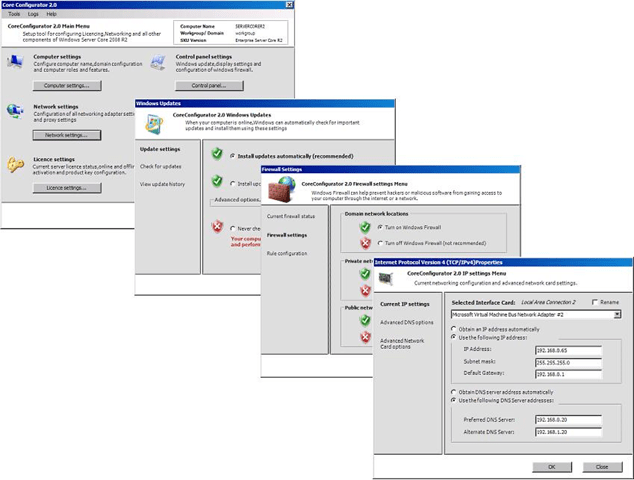 |
Core Configuration taken omvatten:
|
Downloaden doe je HIER
Core Configurator V2 is beschibaar voor Windows Server 2008 R2 Core editie
| |
Core Configuration taken omvatten:
|
Downloaden doe je HIER
Handige samenvattingen van de meest voorkomende procedures en commando’s gebruikt om de Server Core installaties beheren. Klik op het plaatje om bij de download te komen. 

Op Edge van Microsoft Technet staan een heleboel mooie Video’s gemaakt door Microsoft.
Heb er maar even een mooie verzameling van gemaakt.
Zoals normaal je heb je geen “tijd” om alles te lezen of je moet geen leven hebben
Als je iets zit wat je leukt wat er bij zit vindt doe je voordeel er mee.
Windows Server 2008 R2: Remote Desktop Services – The Series (P1)
Windows Server 2008 R2: Remote Desktop Services – The Series (P2)
Windows Server 2008 R2- Remote Desktop Services – The Series (P3)
Windows Server 2008 R2- Remote Desktop Services – The Series (P4)
Windows Server 2008 R2- Remote Desktop Services – The Series (P5)
Part 1 Master Your Environment with System Center Configuration Manager 2007
Part 2 Master Your Environment with System Center Configuration Manager 2007
Part 3 Master Your Environment with System Center Configuration Manager 2007
Part 4 Master Your Environment with System Center Configuration Manager 2007
Hyper-V R2- Failover & Live Migration
Hyper-V R2- Making Highly Available VMs
Hyper-V R2- Making Highly Available VMs
Hyper-V R2- Dynamic Storage
Hyper-V R2- USB over Network with Fabulatech
Hyper-V R2- Introducing Cluster Shared Volumes
Hyper-V R2- Building a Hyper-V R2 Cluster
Hyper-V R2- Initial Installation & Configuration
Demo 1 – Hyper-V Live Migration
Demo 2 – Boot From VHD
Demo 3 – Windows PowerShell 2.0 Remoting
Demo 4 – Active Directory Enhancements
Microsoft Deployment Toolkit – building install media for Windows 7
Windows XP Migration to Windows 7 RC using MDT Beta 1 – Part 1- The OS Install
Windows XP Migration to Windows 7 RC using MDT 2010 Beta 1 – Part 2- How To Build It…
Open Source Software (OSS) on Windows Server 2008
Exchange 2010 Demo: Read and Reply State
Exchange 2010 Demo: Conversation View
Exchange 2010 Demo: Move Conversation
Exchange 2010 Demo: Nickname Cache
Exchange 2010 Demo: UM Card
Interview with Kristian Andaker on Transitions to Exchange Server 2010
Interview with Kristian Andaker on Exchange 2010 OWA
Interview with Matt Gossage on Exchange Server 2010 and Storage
Interview with Scott Schnoll on Exchange 2010 High Availability
Interview with Scott Schnoll on Backup Strategy in Exchange 2010
Interview with Becky Benfield on Exchange 2010 Site Resiliency at Tech Ed 2009
Waarom zijn dagen zo kort!!!!!!!!!!!!!
Hier onder staan de stappen die je moet volgen om de schema uit te breiden naar Windows 2003 R2.
1. Installeer Windows Support Tools.
2. Open command prompt
3. Commando: repadmin /replsum /bysrc /bydest /sort:delta
Controleer of dat de fails op 0 staan.
4. Log in op de domain controller welke de schema beheerder is.
5. Open command prompt en voer het volgende commando in Netdom query FSMO
Hiermee kun je zien op welke domain controller welke rol heeft toegekend gekregen.
Opmerking: Niet alle rollen 1 domain controller. Verdelen is beter
6. Met volgende commando kun je kijken of replicatie goed uitgevoerd
is: repadmin /showrepl
7. Haal van R2 cd de map ADPREP vanaf. Deze vindt je onder cmpnentsR2ADPREP. kopieer
deze naar C: schijf
LET OP is de schema master Windows 2003 x64 geïnstalleerd gebruik dat de r2 x64 om de
schema uit te breiden.
8. Open nu command prompt op de schema master en voer het volgende command uit.
adprep /forestprep Indien je meerdere domeinen hebt moet je mogelijk het volgende
commando mogelijk nog uit adprep /forestprep
Als je adprep /forestprep op forest met maar een domain dan is het domain ook gelijk
bijgewerkt.
SP2 voor Exchange 2007 komt in het derde kwartaal dit jaar.
SP2 voor Exchange 2007 heb je nodig wil je upgraden naar Exchange 2010
Mocht je de SP2 niet willen installeren er komen nog een jaar lang updates uit voor Exchange 2007 SP1 na de release van SP2.
Hieronder de lijst met belangrijkste nieuwe functies in SP2:
Microsoft heeft maandag bekendgemaakt dat Windows 7 nog dit jaar zal worden uitgebracht. De release moet voor de feestdagen een feit zijn. Dinsdag begint het bedrijf met een nieuwe test voor het updatemechanisme van het OS.
De onthulling dat Windows 7 in het vierde kwartaal verschijnt, werd gedaan op de maandag begonnen Microsoft Tech Ed-conferentie te Los Angeles, aldus Microsofts Windows Blog. Een definitieve releasedatum werd nog niet bekent gemaakt. Hoewel al enige tijd wordt verwacht dat het nieuwe besturingssysteem in het najaar verschijnt. Het standpunt van Microsoft was tot dus ver dat het OS maximaal drie jaar na de release van Vista op de markt zou komen, oftewel niet later dan 30 januari 2010. Microsoft heeft overigens voorts laten weten dat ook Windows Server 2008 R2 in het vierde kwartaal wordt vrijgegeven.

1. Enter the productkey:
slmgr.vbs -ipk xxxxx-xxxxx-xxxxx-xxxxx-xxxxx
2. Activate:
slmgr.vbs -ato
3. Show activation:
slmgr.vbs -dli
4. Rename the computer:
Netdom renamecomputer WIN-???????? /newname:W2K8RDC01 /reboot:15
(use the command set to view all the variables used by Microsoft Windows)
5. Show all network interfaces:
Netsh interface ipv4 show interface
6. Set a static IP address:
Netsh interface ipv4 set address name=2 source=static address=xxx.xxx.xxx.xxx mask=255.255.255.0 gateway=xxx.xxx.xxx.xxx
(make sure that you’re choosing the right network interface. In this example it’s 2, so name=2 it means interface 2)
7. Set a static DNS server:
Netsh interface ipv4 add dnsserver name=2 address=xxx.xxx.xxx.xxx index=1
8. Turn Remote Desktop (RDP) on:
Cscript %windir%system32SCRegEdit.wsf /ar 0
9. Enable Remote Desktop (RDP) in the Windows Firewall:
netsh advfirewall firewall set rule group=”remote desktop” new enable=yes
10. Enable Remote Management (RemoteCMD) in the Windows Firewall:
netsh firewall set service type=remoteadmin mode=enable
11. Join the domain:
Netdom join W2K8RDC01 /domain:adtest.local /usero:administrator /passwordo:*
(This step is only for joining a member server to the domain. For a Domain Controller go to step 12)
12. Preparing the promotion to a Read Only Domain Controller:
We need to create a unattend.txt that we are going to use by the DCPROMO. So let’s create a new textfile, type notepad
13. Making the unattended.txt:
Copy and past the following test into the new textfile and save this file on the C: drive of the Core Server.
==================================================
[DCInstall]
InstallDNS=Yes
ConfirmGc=Yes
CriticalReplicationOnly=No
DisableCancelForDnsInstall=No
RebootOnCompletion=Yes
ReplicaDomainDNSName=adtest.local
ReplicaOrNewDomain=ReadOnlyReplica
ReplicationSourceDC=win2k8dc01.adtest.local
SafeModeAdminPassword=******************
SiteName=Default-First-Site-Name
UserDomain=adtest.local
UserName=administrator
Password=******************
RebootOnCompletion=Yes
==================================================
14) Run the DCPROMO
dcpromo /unattend:c:unattend.txt
Ik vond een nice tooltje om Windows Core mee te configureren. Het tootlje is gemaakt door voormalig MVP Guy Teverovsky. Het tooltje heet dan ook Core Configurator.
Hij geeft dit tooltje gemaakt in prive tijd maar dit heeft dit van zijn voormalige werkgever of line moeten halen. Zie het verhaal hier.
Hoezo voor malig MVP: Hij heeft zijn MVP Titel moeten inleveren toen hij voor Microsoft ging werken in Isreal.
Downloaden:
CoreConfigurator.cab
Coreconfigurator.zip
En zo ziet het tooltje er uit: 
1. Start –> Uitvoeren
2. CMD
3. SC Query (Voor een programma tasklist)
4. Onthoudt het PID Nummer
5. Taskkill /pid (Pid Nummer)